

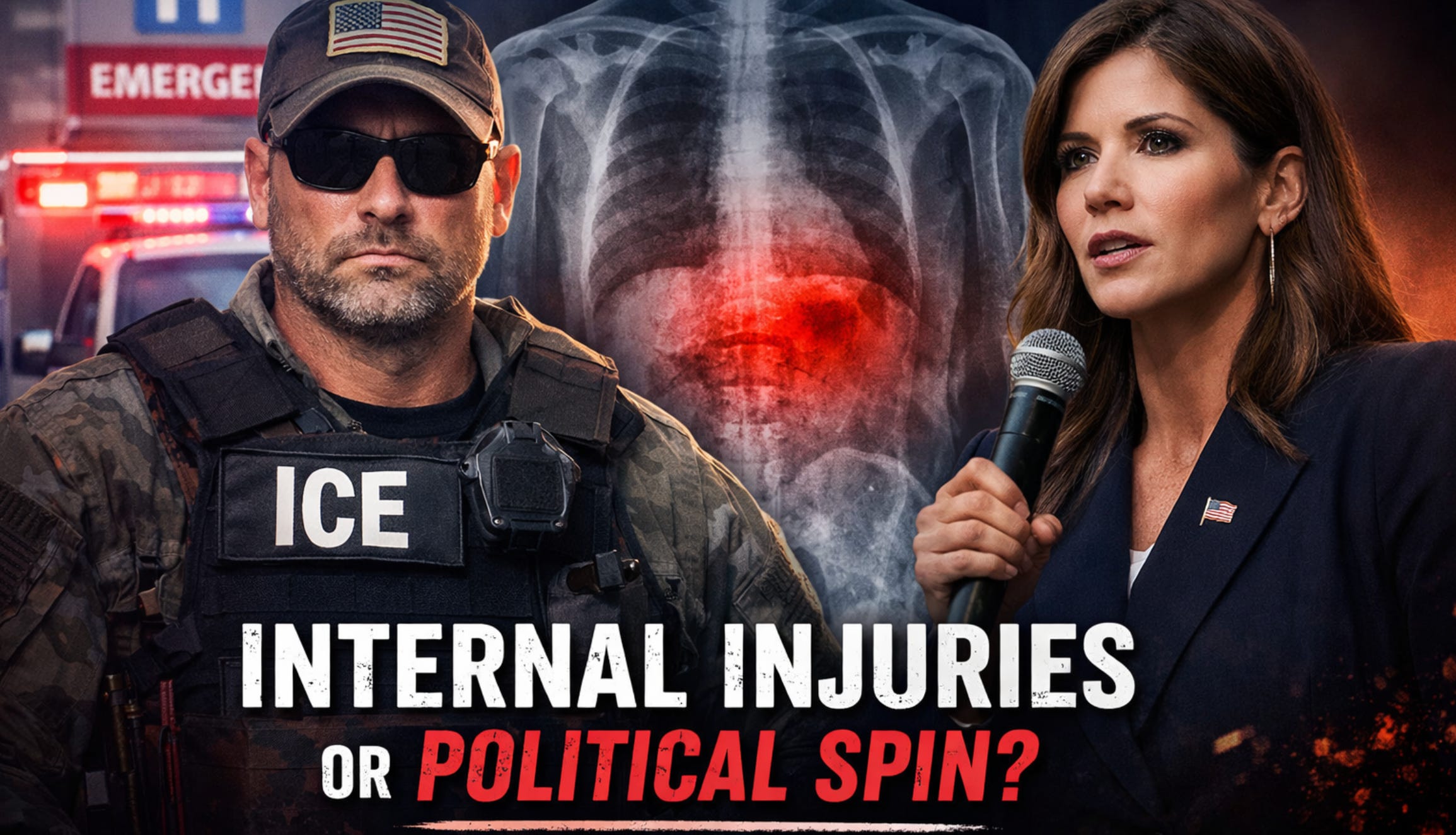
On January 7, 2026, at approximately 9:37 a.m. CST, ICE Agent Jonathan Ross shot and killed 37-year-old Renee Nicole Good in Minneapolis during a federal immigration enforcement operation, a killing that has since ignited national outrage, legal challenges, and protests.
In the hours that followed, Department of Homeland Security officials, including Homeland Security Secretary Kristi Noem, issued statements portraying Ross as a law enforcement professional who had been injured in the encounter, and later DHS released a statement saying that he had suffered “internal bleeding to his torso” but had been taken to a hospital and released the “same day.”
That combination of claims, internal injury and same-day release, does NOT add up.
The Timeline Doesn’t Support a Serious Torso Injury
Let’s be clear: DHS’s own statement, echoed by Noem and other administration spokespeople, emphasizes both the injury and the fact that Ross was treated and released in the same 24-hour period.
When we put a rigorously documented timeline next to that claim, something doesn’t align.
The shooting happened at roughly 9:37 a.m. CST on January 7.
Reporting from outlets tracking Noem’s remarks shows her confirming later that same day that Ross had already been treated and released from the hospital. (The Washington Post live updates report Noem telling reporters “He has been released…” at 5:52 p.m)
Based on that public statement, the maximum possible window between the shooting and confirmed release, even if it happened late in the afternoon, is about 8–9 hours, and almost certainly quite a bit less once time at the scene and transport to the hospital are factored in.
In Medical Reality, Internal Bleeding Isn’t Releasing-The-Same-Day Material
Here’s why that timeline matters:
Experienced emergency physicians don’t release someone quickly if they truly have internal bleeding in the torso.
Internal bleeding, particularly in the chest or abdomen, typically triggers extensive imaging (CT scans), ongoing blood work (including hemoglobin monitoring), and observation that lasts at least 24–48 hours, if not much longer. This isn’t just best practice, it’s necessary because internal bleeding can get worse over time, potentially becoming life-threatening even after initial symptoms seem mild.
In other words, if Ross actually had significant internal bleeding, medical providers would almost never say “he’s fine” after a few hours and discharge him the same day.
But that’s exactly what DHS asserted.
That Inconsistency Cannot Be Ignored
Two conflicting claims have now come from federal officials:
That Agent Jonathan Ross suffered internal bleeding to his torso during the incident.
That he was treated at a hospital and released later that same day.
Those statements don’t naturally coexist under standard medical judgment.
Either:
The injury was never serious internal bleeding in the first place,
orThe description of the injury was embellished for public messaging purposes.
That divergence matters, not just for accuracy, but for public trust.
Why Democrats Are Right to Call This Out
Democratic lawmakers, civil rights advocates, and community leaders have raised urgent questions about this incident on multiple fronts, including use of force, federal agency overreach, and accountability. What this newest inconsistency highlights is a deeper problem:
When federal agencies are defending one of their own in a deadly shooting and pushing a narrative of danger and injury, verifiable medical facts matter.
Words like “internal bleeding to the torso” conjure images of severe trauma: organ damage, blood loss, the kind of injuries that require extended care and close monitoring.
But when someone is back home the same afternoon, that narrative loses credibility.
And in a case where a U.S. citizen has been killed by a federal agent, and local leaders, legal authorities, and community members are demanding accountability, the last thing the public needs is confusing or potentially misleading messaging from the very agencies meant to protect them.
As this case continues to unfold with ongoing FBI investigations, lawsuits, and local protests, the American people deserve factual precision, not spin. When federal officials talk about injury and risk, they should speak in terms that match reality, not rhetoric.
Because in situations where life and death are involved, words matter.
MD here. If you want to really stretch, technically how they describe it could also describe a bruise.
It’s propaganda.
Look at every angle of this incident the car never touched him if he has internal bleeding, it wasn’t from this. Trump and his whole administration and ice are pathological liars.